
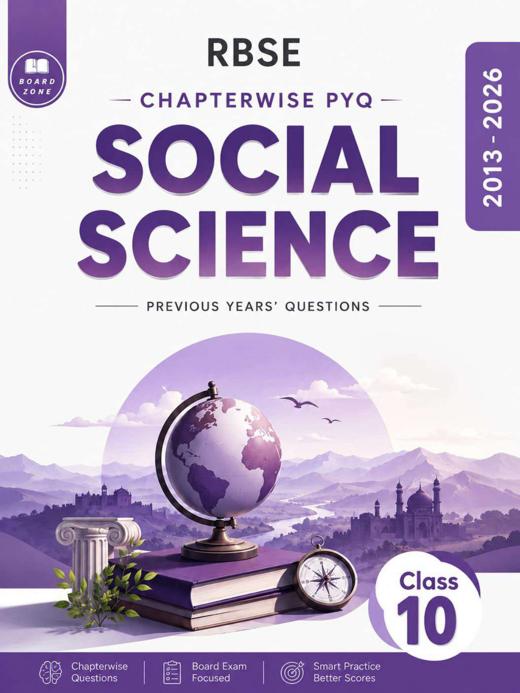




About This Social Science PYQ Book
RBSE Class 10 Social Science - Chapter-wise Previous Year Questions
Ask any Class 10 student in Rajasthan what they do during the last 45 days in exam, and they'll tell you that they study Previous Year Questions Papers. Everyone knows that PYQs are important. Fewer people will know that the way most students go about solving them, is wrong.
Download 8 sets of papers from 2013 to 2021, solve the first one — 1 mark question from History on Nationalism in India followed by a 2-mark question on Water Resources (Geography), then 3-marks question on Federalism (Civics), and finally a 4-marks question on Money and Credit (Economics). At the end of one hour, while your brain is trying to process all four subjects at once, you can barely remember anything you studied.
This book will change that. Chapter 1 (The Rise of Nationalism in Europe) is condensed into one page and all the questions that appeared across board exams (2013 –2026) on this particular chapter are placed right next to it. You study the chapter, and right next to it, you find everything the board expects you to know — all the MCQs that appeared in 2022, 2024, 2025, 2026 grouped together; the 2-mark questions on Napoleonic Code that appeared in 2022 and again in 2024; or the 4-mark question on Romanticism that appeared in 2013 but is still relevant for the exam in 2027. This is what a question-bank meant to help you prepare for an SST exam should look like.
What's in it (and no, we don't mean literally inside)
The book contains 22 chapters of Class 10 RBSE Social Science arranged into 4 sub-subjects as per the books you study from in school:
India and Contemporary II (History): 5 Chapters
- Rise of Nationalism in Europe
- Nationalism in India
- The Making of a Global World
- Age of Industrialization
- Print Culture and the Modern World
Contemporary India II (Geography): 7 Chapters
- Resources and Development
- Forest and Wildlife
- Water Resources
- Agriculture
- Mineral and Energy Resources
- Manufacturing Industries
- Lifelines of National Economy
Democratic Politics II (Civics): 5 Chapters
- Power Sharing
- Federalism
- Gender Religion and Caste
- Political Parties
- Outcomes of Democracy
Understanding Economic Development (Economics): 5 Chapters
- Development
- Sectors of the Indian Economy
- Money and Credit
- Globalization and the Indian Economy
- Consumer Rights
Each chapter follows the same pattern — Section A (MCQ, Fill in the Blanks, and very short answer questions), Section B (Short Answer questions- 2M), Section C (Long answers- 3M), and Section D (Very long answers- 4M). The questions have the marks indicated next to them along with the year they appeared in the exam. Everything you need is right here in one place.
Examples of what "Chapter wise" entails
Opening Chapter 2 (Nationalism in India), you'll find that certain questions have appeared multiple times in the exam, sometimes within consecutive years. The question on Jallianwala Bagh Massacre appeared in 2017, 2018, and 2023. If you're preparing for RBSE board exam 2027, this is a question you need to know — the Rajasthan Board does not shy away from asking the same question repeatedly, and the pattern they follow is visible when you see all the old questions together. Similarly, the Champaran episode has appeared in 2020 and 2022 while the Non-cooperation movement has appeared in 2022, 2025, and once again in 2026. You don't need an educator to tell you which questions are worth practicing — you can see for yourself.
The same trend can be seen in Chapter 1 (Nationalism in Europe) with the mention of Napoleonic Code appearing in 2022 and 2024 or the question on the Unification of Italy which appeared in 2014 and 2023. This is how the Rajasthan Board Class 10 Social Science paper actually works, and after seeing the pattern, you will not want to study for the exam any other way.
Does the data from 2013 hold any value for session 2026?
And now, onto the subject that most students are actually concerned about — the value of the material. We will begin from the end. As per the website, some of the highest scorers in RBSE 2026 were Tanisha Jain, Aditya Raj Chohan, and Simmi Choudhary who all have 99% marks. Over thirty students achieved a 90% score or higher using these BoardZone notes. These are not curated stock images — these are real students, and this is the result of their study.
Additionally, check out the reviews on the page — Karan says "it's great" and then goes on to detail why, including his own thoughts on what the toppers had said. He demonstrates that not only do the high-scorers in RBSE Class 10 use this study material, but it is well-received by the general population as well.
Practical details
Due to being a PDF, you can download the file right after paying ₹59 and save it on your device for as long as you need (until the last day of your RBSE board exam for session 2026-27). Available both in Hindi medium (Samajik Vigyan) as well as English medium. Check out Chapter 1 for yourself (no email required, simply click View Free Sample on the webpage).
If you are studying with the current RBSE textbook, then this SST question-bank is ideal for you since it sticks perfectly to what is taught in the 22 chapters of the course.
Syllabus & paper pattern section
RBSE Class 10 Social Science Paper (Board Exam 2027)
The Rajasthan Board Class 10 Social Science students preparing for the upcoming examination must be well-versed with the following facts:
- 80 marks for theory paper + 20 marks for internal assessment
- Exams to be held in a span of 3 hours 15 minutes
- Paper will be conducted in both Hindi (Samajik Vigyan) and English medium
- The question-paper comprises of 4 sections- A (1-marks), B (2-marks), C (3-marks), and D (4-marks)
- The Rajasthan Board Social Science (SST) paper consists of 4 sub-subjects namely History, Geography, Civics, and Economics. The examination pattern for all the 4 subjects remains the same.
RBSE Class 10 Social Science Syllabus for Board Exam 2027: No changes
The RBSE 10th Class Social Science Syllabus for the Board examination 2027 is consistent with the one the students have been studying through their textbooks. No chapters have been removed or added, and no units have been reorganized. Hence, every question in this book has a place in your exam in 2027.


Leave a Review