




About This Chemistry Notes
Chemistry is the subject where many Class 12 students lose marks they could easily have scored. Physical chemistry has numericals, inorganic chemistry has a lot of facts to remember, and organic chemistry has reactions that all start to look alike close to the exam. These notes put all three in one place, written the way a board answer should be written.
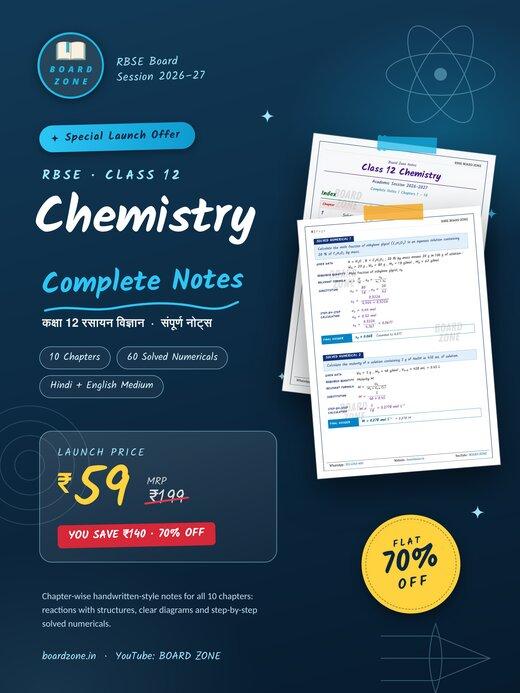
Class 12 Chemistry Handwritten Notes (RBSE 2026-27)
What Makes These Notes Different?
Written the Way a Teacher Explains
Every topic starts from the basics and builds up step by step. Definitions are short and clear, so you can write them straight into your answer sheet.
60 Solved Numericals
Every numerical follows the same five steps: Given Data → Formula → Substitution → Calculation → Final Answer. Once you get used to this pattern, you'll solve any numerical from Solutions, Electrochemistry or Chemical Kinetics the same way and get full marks for the steps.
"Remember This" Boxes
The small points students forget in the exam hall are marked separately, so you see them every time you revise.
"Important Concept" Boxes
The concepts examiners keep coming back to are highlighted, so you know what deserves extra attention.
Easy Difference Tables
Topics that are easy to mix up are given side by side in simple tables, such as the differences between ideal and non-ideal solutions or order and molecularity.
Clear Diagrams
The Daniell cell, salt bridge, electrochemical cells and other diagrams are neatly drawn and labelled, exactly the way you should draw them in the exam.
Handwritten Style, Colour-Coded
The pages look like a topper's notebook. Key words are coloured, so you can revise a whole chapter in a few minutes.
Chapters Covered (All 10)
| No. | English Medium | Hindi Medium |
|---|---|---|
| 1 | Solutions | विलयन |
| 2 | Electrochemistry | वैद्युत रसायन |
| 3 | Chemical Kinetics | रासायनिक बलगतिकी |
| 4 | The d- and f-Block Elements | d- एवं f-ब्लॉक के तत्त्व |
| 5 | Coordination Compounds | उपसहसंयोजन यौगिक |
| 6 | Haloalkanes and Haloarenes | हैलोऐल्केन तथा हैलोऐरीन |
| 7 | Alcohols, Phenols and Ethers | ऐल्कोहॉल, फीनॉल एवं ईथर |
| 8 | Aldehydes, Ketones and Carboxylic Acids | ऐल्डिहाइड, कीटोन तथा कार्बोक्सिलिक अम्ल |
| 9 | Amines | ऐमीन |
| 10 | Biomolecules | जैव-अणु |
Who Should Use These Notes?
- RBSE Class 12 Science students appearing in the 2026-27 board exam.
- Students who want one trusted source instead of jumping between guides, YouTube and class notes.
- Students who find numericals or organic reactions confusing.
- Students preparing for the Half Yearly and pre-board exams.
How to Study Using These Notes
- First reading: Go through one chapter slowly and understand each concept before you move on.
- Numericals: Close the solution and solve each numerical yourself first, then match your steps with the notes.
- Revision: In the last weeks, read only the coloured lines, the "Remember This" boxes and the difference tables.
- Before the exam: Practise drawing every diagram once with labels.
Hindi Medium or English Medium?
Both are available as separate PDFs (कक्षा 12 रसायन विज्ञान नोट्स in Hindi medium). Each has the same 10 chapters, in the same order, with the same 60 solved numericals.
The Hindi version uses the same technical terms as the RBSE board papers (जैसे मोलरता, वैद्युत अपघट्य, अभिक्रिया की कोटि), so you won't get confused in the exam. Pick the medium you're writing your board exam in.


Leave a Review