
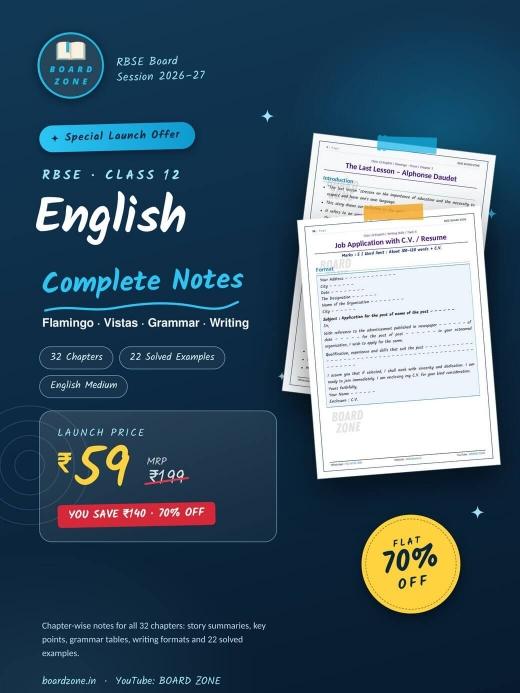




About This English Notes
Many students start Class 12 English thinking it's the easy paper. Then they open Flamingo, Vistas, the grammar book and the writing formats at the same time and don't know where to start. These notes are made for that moment.
We've put the whole Class 12 English Compulsory course into one PDF: 106 pages, chapter by chapter, in short points you can actually remember. You don't need a guide, a separate grammar book and a pile of formats from different places. Everything is here, in the order you'll study it.
The notes follow the RBSE syllabus for the 2026-27 session, so the grammar section has the new topics, like Conditional Sentences and Prepositions, and drops the ones that have been removed.
What's inside the notes
Flamingo – Prose (8 chapters)
- The Last Lesson – Alphonse Daudet
- Lost Spring: Stories of Stolen Childhood – Anees Jung
- Deep Water – William O. Douglas
- The Rattrap – Selma Lagerlöf
- Indigo – Louis Fischer
- Poets and Pancakes – Asokamitran
- The Interview – Christopher Silvester
- Going Places – A. R. Barton
Flamingo – Poetry (5 poems)
- My Mother at Sixty-Six – Kamala Das
- Keeping Quiet – Pablo Neruda
- A Thing of Beauty – John Keats
- A Roadside Stand – Robert Frost
- Aunt Jennifer's Tigers – Adrienne Rich
Vistas – Supplementary Reader (8 chapters)
- The Third Level – Jack Finney
- The Tiger King – Kalki Krishnamurthy
- Journey to the End of the Earth – Tishani Doshi
- The Enemy – Pearl S. Buck
- Should Wizard Hit Mommy? – John Updike
- On the Face of It – Susan Hill
- Evans Tries an O-Level – Colin Dexter
- Memories of Childhood – Zitkala-Sa and Bama
English Grammar (4 topics)
- Conditional Sentences
- Prepositions
- Phrasal Verbs
- Conjunctions
Writing Skills (7 topics)
- Notice
- Invitation & Reply
- Report Writing
- Article / Paragraph Writing
- Letter to the Editor
- Job Application with C.V. / Resume
- Formal Letter / Application to an Authority
How each chapter is written
Every Flamingo and Vistas chapter follows the same simple pattern, so you always know where to look:
- Introduction: What the chapter is about and the message behind it.
- Background: Where it's needed, for example the Franco-Prussian war in The Last Lesson.
- Summary: The full story in short bullet points, in the right order.
- Key points: The lines you should keep in mind for long answers.
- Theme: The central idea, written so you can use it directly in your answer.
Take Lost Spring. Saheb's story and Mukesh's story are kept separate, and the "vicious cycle" of poverty, moneylenders, middlemen, police and tradition is listed point by point, which is exactly how examiners like to see it.
Grammar that's actually easy to follow
Students lose the most marks in grammar, so we've given these four topics extra care. Each topic has:
- A clear definition and its types
- Tables and formulas, for example all five types of conditional sentences with their if-clause and main-clause structure
- Important rules, like why we never use will in an if-clause, and how unless works
- Solved examples
- Common errors students make in the exam
- How to solve questions step by step
Writing skills with ready formats
Each writing topic gives you the exact format (sender's address, date, subject, salutation, closing and so on) along with solved samples. Learn the format once and you won't lose the easy format marks in any letter, notice, report or job application.
Who these notes are for
- Students who want to revise the full book in less time before the half yearly or the board exam.
- Students who find NCERT chapters long and want the main points without missing anything.
- Students who are weak in grammar and want rules with examples in one place.
- Anyone who keeps forgetting the format of a notice, report or letter.
How to get the most out of these notes
- Read the chapter in your textbook once, then read our notes for that chapter.
- Learn the key points and the theme. These two parts help in almost every long answer.
- Do the grammar section daily, one topic at a time, and check yourself against the common errors.
- Write each writing-skill format by hand at least twice. Writing it out is how it sticks.
- In the last week before the exam, revise only from these notes.


Leave a Review