
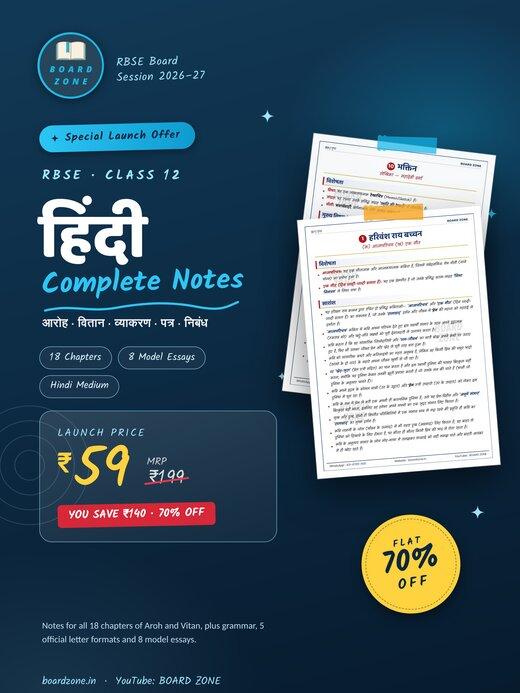




About This Hindi Notes
Most students don't study Hindi seriously because it feels like the easy subject. Then the exam paper comes, and marks slip away in the letter format, an अलंकार example, or a सप्रसंग व्याख्या that doesn't follow the right structure. In Hindi, good marks come from writing in the right format and remembering the right points. These notes are built around exactly that.
Class 12 Hindi Handwritten Notes (RBSE 2026-27)
What Makes These Notes Different?
Full Syllabus in One PDF
Grammar, writing skills, Aroh, Vitan and author introductions are all in one place, so you don't have to put your preparation together from three different books.
Easy Summary for Every Chapter
Every poem and prose chapter starts with its विशेषता (genre, style, source collection), followed by a point-wise सारांश in simple language. Prose chapters also explain the मुख्य विषय (main theme), which is what most long-answer questions are based on.
Ready-to-Use Letter Formats
The notes give proper formats for all five types of office letters: निविदा सूचना, विज्ञप्ति, अर्द्ध-शासकीय पत्र, अधिसूचना and ज्ञापन. Learn the format once, and you won't lose marks for the layout.
8 Exam-Ready Essays
The essays include स्वच्छ भारत अभियान, डिजिटल इंडिया, बेटी बचाओ बेटी पढ़ाओ, जल संरक्षण, जनसंख्या, राष्ट्रीय एकता, भारतीय किसान and मेक इन इंडिया. There is also a short guide on how to write any essay, so you can handle a topic you haven't prepared.
सप्रसंग व्याख्या Made Simple
The notes show the exact structure for writing a पद्यांश or गद्यांश व्याख्या, with solved examples from पतंग and शिरीष के फूल. This is the question students most often get wrong.
Author Introductions in Table Form
For each prose author, the notes give the date and place of birth, education, major works by genre, awards and the chapter in your textbook, all in a clean table that's easy to memorise.
Handwritten Style, Colour-Coded
The pages look like a topper's notebook. Important words are highlighted, so revising a whole chapter takes only a few minutes.
What's Covered (9 Parts)
| Part | Topic | What's Inside |
|---|---|---|
| 1 | हिंदी व्याकरण | भाषा, व्याकरण एवं लिपि; शब्द-शक्ति; अलंकार; पारिभाषिक शब्दावली |
| 2 | कार्यालयी पत्र-लेखन | निविदा सूचना, विज्ञप्ति, अर्द्ध-शासकीय पत्र, अधिसूचना, ज्ञापन |
| 3 | निबंध लेखन | Essay-writing method + 8 essays |
| 4 | अभिव्यक्ति एवं माध्यम | विभिन्न माध्यमों के लिए लेखन, विशेष लेखन, नाट्य-रूपांतरण / रेडियो नाटक |
| 5 | सप्रसंग व्याख्या | पद्यांश एवं गद्यांश format with examples |
| 6 | लेखक परिचय | महादेवी वर्मा, जैनेंद्र कुमार, धर्मवीर भारती, फणीश्वर नाथ 'रेणु', हजारी प्रसाद द्विवेदी, भीमराव अंबेडकर |
| 7 | आरोह भाग-2 : काव्य खंड | 9 poets, from हरिवंश राय बच्चन to उमाशंकर जोशी |
| 8 | आरोह भाग-2 : गद्य खंड | भक्तिन to श्रम विभाजन और जाति-प्रथा |
| 9 | वितान भाग-2 | सिल्वर वैडिंग, जूझ, अतीत में दबे पाँव |
Chapters Covered – Aroh & Vitan
आरोह भाग-2 (काव्य खंड)
- आत्मपरिचय · एक गीत – हरिवंश राय बच्चन
- पतंग – आलोक धन्वा
- कविता के बहाने · बात सीधी थी पर – कुँवर नारायण
- कैमरे में बंद अपाहिज – रघुवीर सहाय
- उषा – शमशेर बहादुर सिंह
- बादल राग – सूर्यकांत त्रिपाठी 'निराला'
- कवितावली · लक्ष्मण-मूर्च्छा और राम का विलाप – तुलसीदास
- रुबाइयाँ · गज़ल – फ़िराक गोरखपुरी
- छोटा मेरा खेत · बगुलों के पंख – उमाशंकर जोशी
आरोह भाग-2 (गद्य खंड)
- भक्तिन – महादेवी वर्मा
- बाज़ार दर्शन – जैनेंद्र कुमार
- काले मेघा पानी दे – धर्मवीर भारती
- पहलवान की ढोलक – फणीश्वर नाथ 'रेणु'
- शिरीष के फूल – हजारी प्रसाद द्विवेदी
- श्रम विभाजन और जाति-प्रथा · मेरी कल्पना का आदर्श समाज – भीमराव अंबेडकर
वितान भाग-2
- सिल्वर वैडिंग – मनोहर श्याम जोशी
- जूझ – आनंद यादव
- अतीत में दबे पाँव – ओम थानवी
Who Should Use These Notes?
- RBSE Class 12 students of any stream (Science, Commerce or Arts) appearing in the 2026-27 board exam.
- Students who keep losing marks on letter formats, essays or व्याख्या.
- Students who want to finish Hindi quickly and spend more time on their main subjects.
- Students preparing for the Half Yearly and pre-board exams.
How to Study Using These Notes
- Start with writing skills (Parts 2–5). Letters, essays, Abhivyakti and व्याख्या carry a large share of the marks and take the least time to learn.
- Read one chapter summary a day from Aroh and Vitan. Focus on the विशेषता and मुख्य विषय, because that's what the questions ask about.
- Learn the author tables for the prose writers. Questions on birth details and major works come up almost every year.
- Before the exam: Write one letter and one व्याख्या by hand to practise the format.


Leave a Review