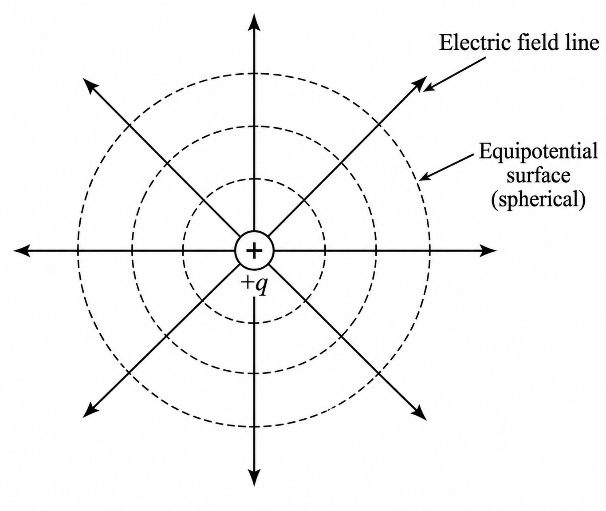
Draw an equipotential surface for a positive charge (q > 0).
किसी एकल धनावेश (q > 0) के लिए समविभव पृष्ठ बनाइए।
🔥 Most repeated · asked 3×
All solved questions for this chapter are in the full RBSE Physics PYQ book.
स्थिरवैद्युत विभव तथा धारिता — बार-बार पूछे जाने वाले प्रश्न
Last updated: 5 July 2026
Every RBSE Class 12 Physics board paper from 2013 to 2026 for Electrostatic Potential and Capacitance, sorted and tagged so you know exactly which equipotential-surface and capacitor derivations to revise first.
Real previous-year questions with the exact RBSE board years they appeared in — each with its full board solution. 5 more high-yield questions — including two more capacitor derivations — are in the free PDF.
Draw an equipotential surface for a positive charge (q > 0).
किसी एकल धनावेश (q > 0) के लिए समविभव पृष्ठ बनाइए।
🔥 Most repeated · asked 3×
All solved questions for this chapter are in the full RBSE Physics PYQ book.
Define equipotential surface.
समविभव पृष्ठ की परिभाषा लिखिए।
🔁 Repeated · asked 2×An equipotential surface is a surface in an electric field where the electric potential is the same at every point
All solved questions for this chapter are in the full RBSE Physics PYQ book.
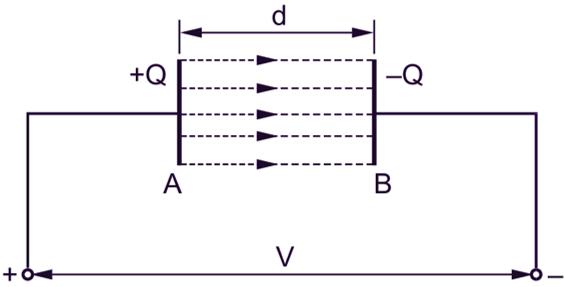
If the area of each conducting plate of a parallel plate capacitor is A and d is the separation between them, then derive its capacitance formula.
यदि एक समान्तर प्लेट संधारित्र की प्रत्येक चालक प्लेट का क्षेत्रफल A है तथा उनके बीच पृथक्कन d है, तो इसकी धारिता का सूत्र व्युत्पन्न कीजिए।
⚙️ Core capacitor derivation
Let us take a parallel plate capacitor having plate area A . ' d ' is the dist. b/w the plates. If σ is the surface charge density then
Eout =σ/2ϵ0-σ/2ϵ0=0
Ein =σ/2ϵ0+σ/2ϵ0=σ/ϵ0 eq1
Also,
E=V/d
σ/ϵ0=V/d and σ/ϵ0=Q/Cd (Q=CV)
σ/ϵ0=Q/Cd
Q/Aϵ0=Q/Cd (∵σ=Q/A)
C=ϵ0A/d
C∝A and C∝1/d
All solved questions for this chapter are in the full RBSE Physics PYQ book.
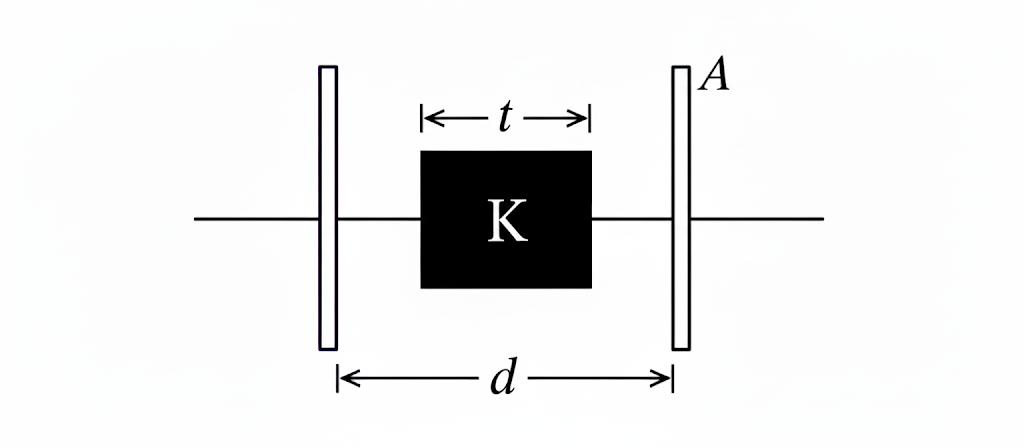
Define electric capacity. Derive an expression for the capacitance of a parallel plate capacitor in which a dielectric medium of dielectric constant K fills the space between the plates. Draw the necessary diagram.
विद्युत धारिता की परिभाषा लिखिए। एक समान्तर पट्ट संधारित्र को प्लेटों के बीच K परावैद्युतांक का माध्यम भरा हुआ है। इसकी धारिता का व्यंजक प्राप्त कीजिए। आवश्यक चित्र बनाइए।
⭐ High-weightage derivationElectric capacity, or capacitance (C), is the ability of a conductor or a system of conductors (a capacitor) to store electric charge


Let us take a parallel plate capacitor of dimensions A and d . A dielectric slab of dielectric constant K and thickness t is inserted between the plates of the capacitor as shown
Vn=Vc+Vs
Vn=Ec(d-t)+Est (E=V/l)
Vn=σ/ϵ0(d-t)+σ/ϵt
Vm=σ/ϵ0(d-t)+σ/Kϵ0t
Vm=σ/ϵ0(d-t+t/K)
Also,
C=Q/Vm
C=σA/(σ/ϵ0(d-t+t/K))
C=ϵ0A/(d-t+t/K)
Also, t=d
C=ϵ0A/(d-d+d/K)
C=ϵ0A/(d/K)
C=(ϵ0A/d)K
C=KC0
All solved questions for this chapter are in the full RBSE Physics PYQ book.
What is meant by energy stored in a capacitor? Prove that the ratio of change in potentials of two charged conductors, after they are connected, is inversely proportional to their capacitances.
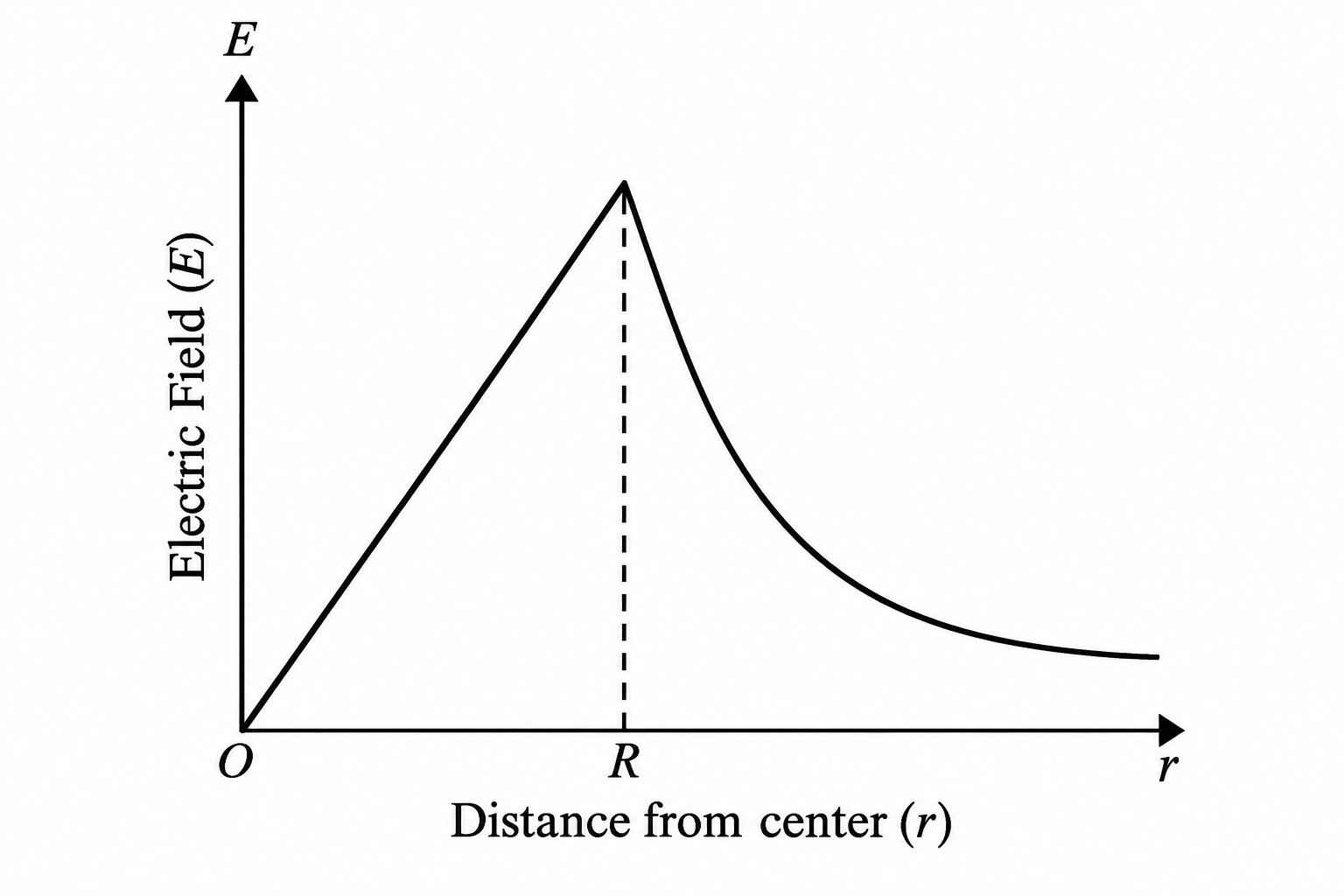
संधारित्र में संचित ऊर्जा से क्या तात्पर्य है? सिद्ध कीजिए- "दो आवेशित चालकों को जोड़ने पर उनके विभव में परिवर्तनों का अनुपात चालकों की धारिताओं के व्युत्क्रमानुपाती होता है।" समरूप आवेशित अचालक गोले के कारण विद्युत क्षेत्र व दूरी के मध्य आरेख बनाइये।
📌 Frequently examined proof(1) Energy Stored in a Capacitor:
When a capacitor is charged, work is done in transferring charge from one plate to another against the electric field. This work is stored in the form of electrostatic potential energy in the capacitor. U=1/2CV2=Q2/2C=1/2Q V
(2) To Prove:
"The ratio of change in potentials of two conductors after connection is inversely proportional to their capacitances."
Let two conductors of capacitances C1 and C2 have initial potentials V1 and V2 . After connection, common potential is obtained
Change in potentials are: ΔV1=V1-V, ΔV2=V-V2
Since charge lost by one = charge gained by other, C1(V1-V)=C2(V-V2) ⇒((V1-V))/((V-V2))=C2/C1
Thus, Ratio of change in potentials =ΔV1/ΔV2∝1/C
(3) Curve between Electric Field (E) and Distance (r) for Uniformly Charged Non-Conducting Sphere:
Inside the sphere ( r<R ): E=ρr/3ε0→ increases linearly with distance
Outside the sphere ( r≥R ): E=1/4πε0Q/r2→ decreases as inverse square of distance
All solved questions for this chapter are in the full RBSE Physics PYQ book.

The other 5 are in the free PDF — and all 30 previous-year questions for this chapter are in the full book.
Get 10 hand-picked previous-year questions from Chapter 2. Every question includes the exam year, marks, and repeat count. Instant download—no signup required.
A quick map of the chapter before you download — so you know what the questions are testing.
If you have gone through the last decade of RBSE Class 12 Physics papers, you will notice Chapter 2 rarely surprises anyone. It belongs to Unit I – Electrostatics and reliably contributes around 6–8 marks to the paper every year — enough that skipping it is simply not an option. What changes from year to year is small; the shape of the questions stays remarkably steady.
You can expect a quick 1-mark opener — a definition or a diagram, most often the equipotential surface for a positive charge, which has already been asked in 2016, 2021 and 2024. Then come the 1.5 to 2-mark numericals on electric potential due to a point charge or a charged spherical shell, and the potential energy of a system of charges. The heavy marks sit in the 4-mark long answers, which almost always ask you to derive the capacitance of a parallel-plate capacitor (with or without a dielectric of constant K), or to prove a result about capacitors combined in series and parallel.
So the smart way to revise this chapter is not to read it end to end, but to practise the questions RBSE actually repeats. The five questions above — and the ten in the free sample PDF — are taken straight from real board papers and tagged with the exact years they appeared, so you can see for yourself what the full RBSE Physics chapterwise PYQ book offers before you decide to buy it.
The RBSE syllabus sub-topics this chapter's PYQs are drawn from — useful for scoping your revision even if you're not buying the full book.
"Chapter 2 ke equipotential surface wale question har saal ghoom fir ke aa jaate hain — is list se pata chal gaya kaunse pehle karne hain."
"Free PDF mein hi 10 solid questions mil gaye, wo bhi bina kisi login jhanjhat ke. Capacitor wale derivation questions bahut kaam aaye."
"Year-wise tags dekh kar revision plan banana easy ho gaya. Poora 14-chapter book bhi le liya sirf ₹59 mein, paisa vasool."
The ₹59 full book unlocks all 30 tagged previous-year questions for Electrostatic Potential and Capacitance — plus all 13 other chapters.
Every MCQ, VSA, SA and long-answer question for this chapter from RBSE papers 2013–2026 — 30 in total.
Each question labelled with year, marks and question type.
Highest-repeated questions listed first so revision time is spent well.
Full bilingual coverage — study in whichever medium you write your exam.
Quick-reference sheet of every potential and capacitance formula in the chapter.
Updated to the latest RBSE board pattern, with access valid for the current 2026–27 exam session.
One booklet, every chapter, tagged and sorted by repeat priority — in English and Hindi.
See full book — ₹59 →