Define: (A) Nuclear fission (B) Nuclear fusion.
परिभाषित कीजिए : (A) नाभिकीय विखंडन (B) नाभिकीय संलयन।
🔥 Most repeated · asked 2×नाभिक — बार-बार पूछे जाने वाले प्रश्न
Last updated: 5 July 2026
Every RBSE Class 12 Physics board paper from 2013 to 2026 for Nuclei, sorted and tagged so you know exactly which mass-defect, binding-energy-per-nucleon and nuclear-fission/fusion questions to revise first.
Real previous-year questions with the exact RBSE board years they appeared in. 5 more high-yield questions — including nuclear-density and nuclear-force questions — are in the free PDF.
Define: (A) Nuclear fission (B) Nuclear fusion.
परिभाषित कीजिए : (A) नाभिकीय विखंडन (B) नाभिकीय संलयन।
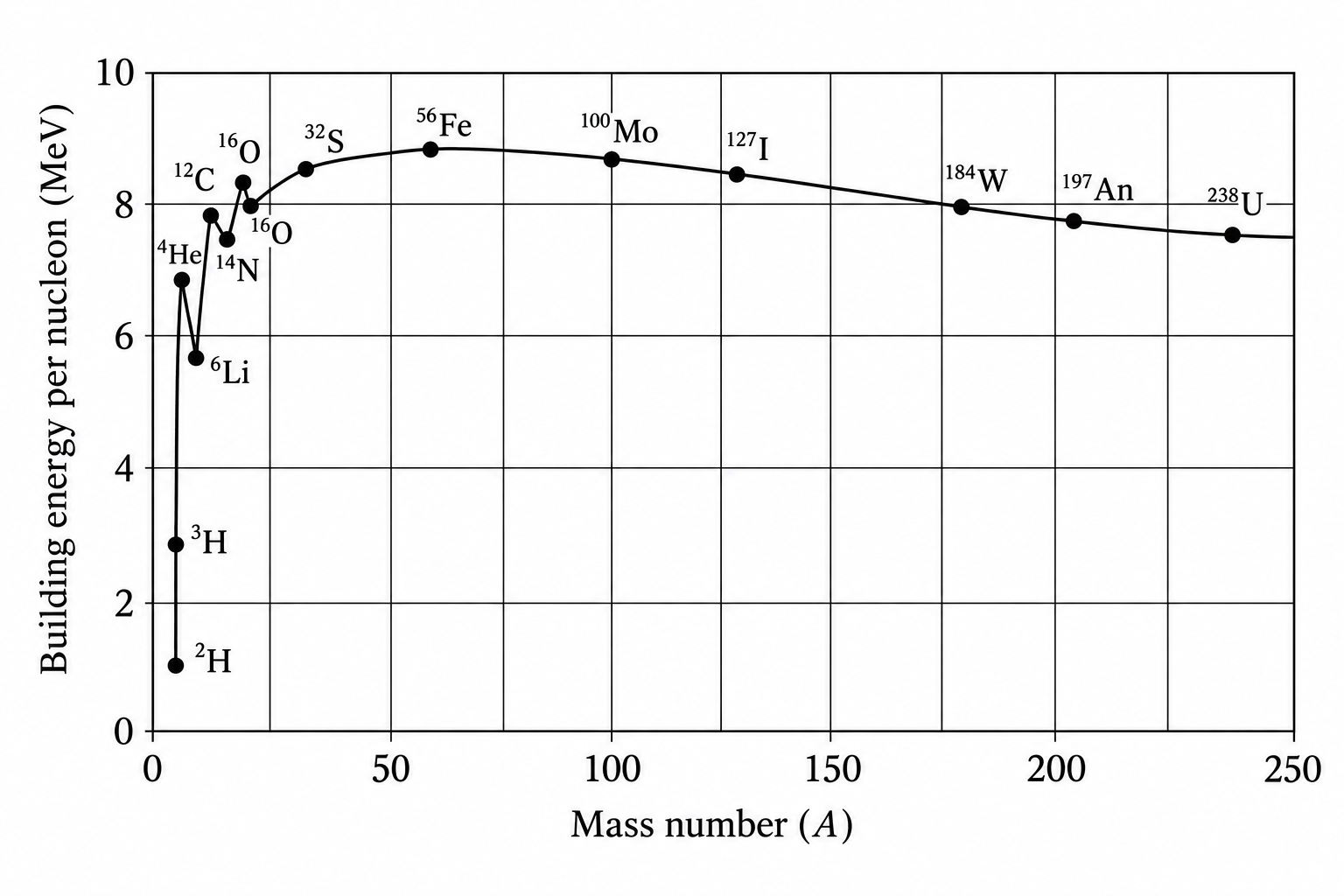
🔥 Most repeated · asked 2×What is meant by mass defect and nuclear binding energy? Draw a graph between mass number and binding energy per nucleon.
द्रव्यमान क्षति एवं नाभिकीय बंधन ऊर्जा से क्या तात्पर्य है ? द्रव्यमान संख्या एवं प्रति न्यूक्लिऑन बंधन ऊर्जा के मध्य आरेख बनाइए।
⭐ High-weightage derivationWhat do you understand by nuclear force? Draw the graph of binding energy per nucleon as a function of mass number and explain it.
नाभिकीय बल से आपका क्या आशय है ? प्रति न्यूक्लिऑन बंधन ऊर्जा का द्रव्यमान संख्या के फलन के रूप में ग्राफ खींचकर समझाइये।
⚙️ Core conceptDefine mass defect of a nucleus. The binding energy of oxygen (₈O¹⁶) is 127.5 MeV. Find its binding energy per nucleon, and state the value of 1 eV in joules.
किसी नाभिक की द्रव्यमान क्षति को समझाइए। ₈O¹⁶ की बंधन ऊर्जा 127.5 MeV है तो इसकी 'बंधन ऊर्जा प्रति न्यूक्लिऑन' का मान लिखिए। 1 eV का मान जूल में लिखिए।
📌 Core numericalFrom the equation R = R₀·A^(1/3), show that the nuclear matter density is nearly constant (where R₀ is a constant and A is the mass number).
समीकरण R = R₀A^(1/3) के आधार पर दर्शाइए कि नाभिकीय द्रव्य का घनत्व लगभग अचर रहता है। (यहाँ R₀ एक नियतांक तथा A द्रव्यमान संख्या है)।
⚙️ Core proofThe other 5 are in the free PDF — and all 15 previous-year questions for this chapter are in the full book.
Get 10 hand-picked previous-year questions from Chapter 13. Every question includes the exam year, marks, and repeat count. Instant download—no signup required.
A quick map of the chapter before you download — so you know what the questions are testing.
If you have gone through the last decade of RBSE Class 12 Physics papers, you will notice Chapter 13 (Nuclei) is tested every year without fail. It belongs to Unit VIII — Atoms and Nuclei and is drawn from a pool of 15 previous-year questions spanning 2013–2026, spread across MCQs, very short, short and long-answer sections. The topics rotate, but the question patterns stay remarkably steady.
This is the shortest chapter in the book — just 15 previous-year questions — so every one of them is worth knowing well. Expect 1-mark openers on mass defect, nuclear fusion, or Einstein's mass-energy relation, and 2 to 3-mark questions on the binding-energy-per-nucleon graph and proving nuclear-matter density is nearly constant.
So the smart way to revise this chapter is not to read it end to end, but to practise the questions RBSE actually repeats. The five questions above — and the ten in the free sample PDF — are taken straight from real board papers and tagged with the exact years they appeared, so you can see for yourself what the full RBSE Physics chapterwise PYQ book offers before you decide to buy it.
The RBSE syllabus sub-topics this chapter's PYQs are drawn from — useful for scoping your revision even if you're not buying the full book.
"Sabse chhota chapter hai but binding energy wala graph question important hai, list se clear ho gaya."
"15 hi questions the poore chapter mein, free sample mein hi zyada tar cover ho gaye."
"Year-wise tags dekh kar revision plan banana easy ho gaya. Poora 14-chapter book bhi le liya sirf ₹59 mein, paisa vasool."
The ₹59 full book unlocks all 15 tagged previous-year questions for Nuclei — plus all 13 other chapters.
Every MCQ, VSA, SA and long-answer question for this chapter from RBSE papers 2013–2026 — 15 in total.
Each question labelled with year, marks and question type.
Highest-repeated questions listed first so revision time is spent well.
Full bilingual coverage — study in whichever medium you write your exam.
Quick-reference sheet of every nuclei formula — mass-defect, binding-energy and nuclear-radius formulas.
Updated to the latest RBSE board pattern, with access valid for the current 2026–27 exam session.
One booklet, every chapter, tagged and sorted by repeat priority — in English and Hindi.
See full book — ₹59 →