
Chapter 04 · Unit III — Magnetic Effects of Current and Magnetism · Physics

RBSE Class 12 Physics Chapter 4 — Moving Charges and Magnetism: Most Repeated Questions (2013–2026)

गतिमान आवेश तथा चुंबकत्व — बार-बार पूछे जाने वाले प्रश्न

Last updated: 5 July 2026

Every RBSE Class 12 Physics board paper from 2013 to 2026 for Moving Charges and Magnetism, sorted and tagged so you know exactly which Biot–Savart-law, Ampere's-circuital-law and moving-coil-galvanometer questions to revise first.

10
Free PYQs
31
Total PYQs
2013–26
Years covered
EN+हिंदी
Both mediums

Top 5 most-repeated RBSE Class 12 Physics PYQs — Moving Charges and Magnetism

Real previous-year questions with the exact RBSE board years they appeared in — each with its full board solution. 5 more high-yield questions — including two more Ampere's-law derivations — are in the free PDF.

01
4 Marks Very Long Answer

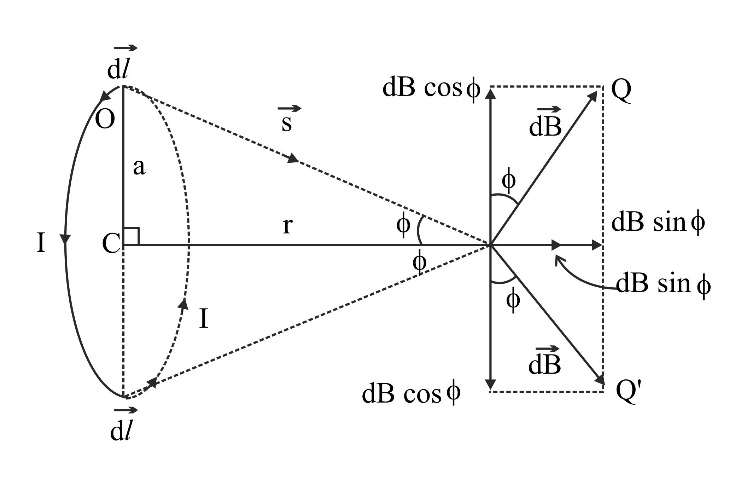
Write the formula of Biot-Savart law in vector form. Obtain an expression of magnetic field on the axis of a current-carrying loop. Draw the necessary diagram.

बायो-सावर्ट नियम लिखिए। एक विद्युत धारावाही पाश के अक्ष पर स्थित बिन्दु पर चुम्बकीय क्षेत्र ज्ञात कीजिए। आवश्यक चित्र बनाइए।

🔥 Most repeated · asked 5×
Solution

Biot savart formula=| dB⃗ | =μ0/4πIdlsinθ/r2
diagram

Let us take a circular loop of radius r carrying current I . We have to find the magnetic field at point P which is at axial distance a from the center. By resolving the magnetic field vector of every dl element, we can observe that all the cos component will cancel out whereas the sin component will add up:

So, B=∫dBsinα

B=∫μ0Idlsinθsinα/(4π(√(r2+a2))2)

B=(μ0Isin90∘×sinα)/(4π(r2+a2))∫dl

> From the geometry, sinα=r/(√(r2+a2)) and ∫dl=2πr

B=μ0I/(4π(r2+a2))(r/(√(r2+a2)))2πr; B=μ0I2πr2/(4π(r2+a2)3/2); B=μ0Ir2/(2(r2+a2)3/2); B=μ0Ir2/(2(r2+a2)3/2)

For N turns

B=μ0NIr2/(2(r2+a2)3/2)

If a=0

B=μ0NIR2/(2(r2+a2)3/2); B=μ0NIR2/(2(r2)3/2); B=μ0NIR2/2r3; B=μ0NI/2r

All solved questions for this chapter are in the full RBSE Physics PYQ book.
Appeared in RBSE 2026 2025 2024 2021 2017
02
4 Marks Very Long Answer

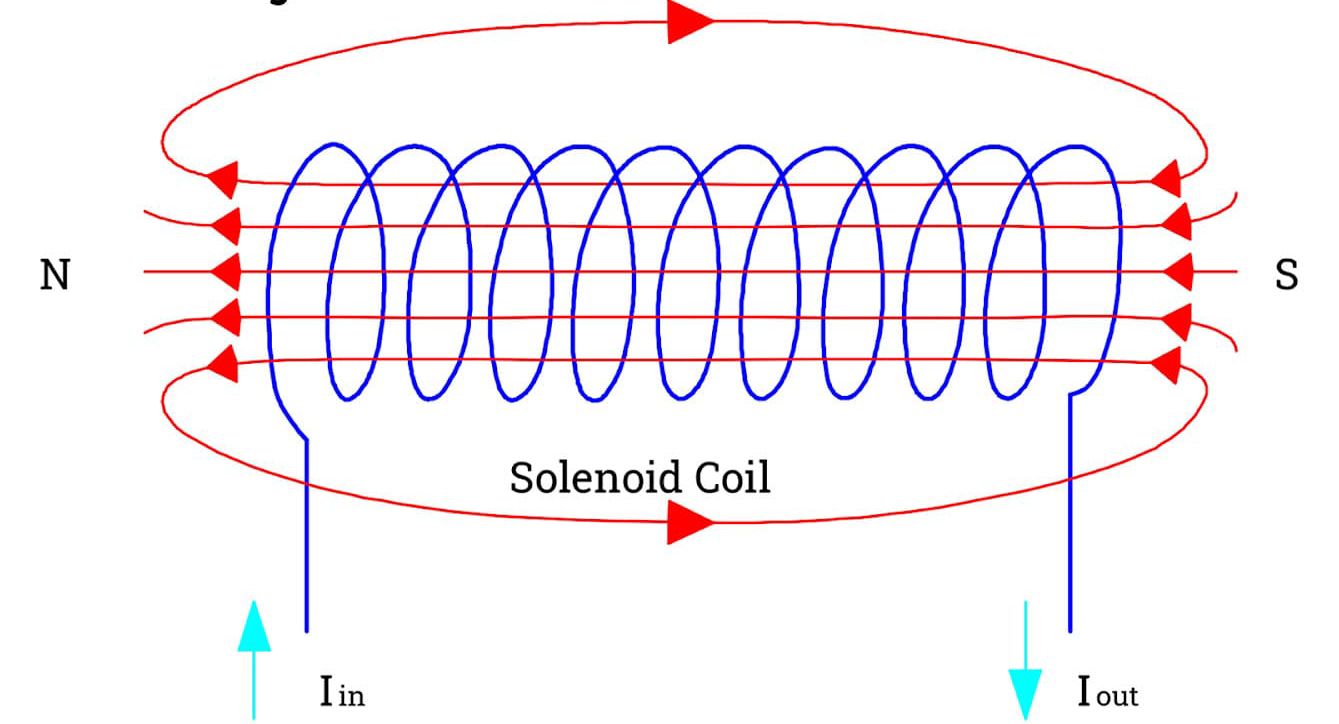
Write Ampere's circuital law in mathematical form. Draw a diagram and derive an expression for the magnetic field on the axis of a current-carrying solenoid.

एम्पियर का परिपथीय नियम गणितीय रूप में लिखिए। किसी लम्बी धारावाही परिनालिका के अक्ष पर चुम्बकीय क्षेत्र का व्यंजक व्युत्पन्न कीजिए। आवश्यक चित्र बनाइये।

🔁 Repeated · asked 3×
Appeared in RBSE 2026 2019 2017
03
4 Marks Very Long Answer

Write Ampere's circuital law. Obtain an expression for the magnetic field on the axis of a current-carrying very long solenoid. Draw the necessary diagram.

ऐम्पियर का परिपथीय नियम लिखिए। एक अत्यधिक लम्बी धारावाही परिनालिका के अक्ष पर चुम्बकीय क्षेत्र का व्यंजक प्राप्त कीजिए। आवश्यक चित्र बनाइए।

🔁 Repeated · asked 2×
Solution

Ampère's Circuital Law states that the line integral of the magnetic field (B⃗) around any closed loop is equal to μ0 times the net electric current ( Ienclosed ) passing through that loop

∮B⃗⋅dl⃗=μ0Ienclosed

Let us take a solenoid carrying current I . If L is length of the solenoid, R is its radius, n is no. of turns and A is area of cross-section and it is kept in free space. Then also considering rectangular Ampère's loop of dimension l×b

Assuming, n=( no. of turns )/( length )⇒n=N/L

diagram

ACC. to A.C.L.:

⇒∮B⃗⋅dl⃗=μ0Ienclosed ; ⇒∫ABB⃗⋅dl⃗+∫BCB⃗⋅dl⃗+∫CDB⃗⋅dl⃗+∫DAB⃗⋅dl⃗=μ0Ienclosed ; ⇒∫ABBdlcos90∘+∫BCBdlcos0∘+∫CDBdlcos90∘+0=μ0Ienclos ; ⇒∫BCBdl=μ0Ienclosed ; ⇒B∫BCdl=μ0Ienclosed ; ⇒B×l=μ0(I× no. of turns ); ⇒Bl=μ0(Inl) [ from (1)] ; ⇒B=μ0nI= constant

All solved questions for this chapter are in the full RBSE Physics PYQ book.
Appeared in RBSE 2017 2015
04
4 Marks Very Long Answer

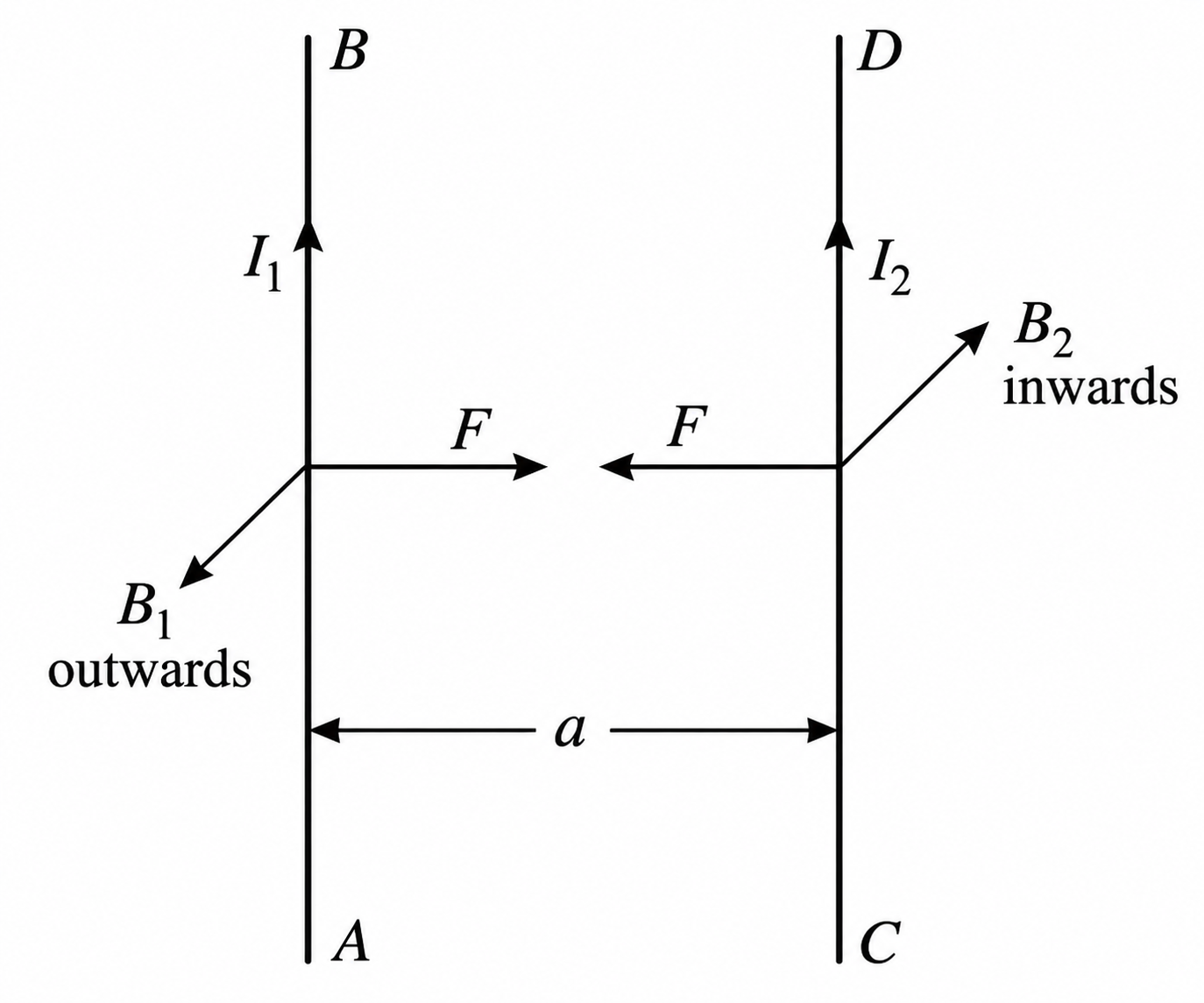
Derive an expression for the force per unit length acting between two straight parallel current-carrying conductors. Define the standard unit of current on this basis.

दो सीधे समान्तर धारावाही चालकों के बीच प्रति इकाई लम्बाई पर बल का व्यंजक प्राप्त कीजिए। किस अवस्था में यह बल आकर्षण व प्रतिकर्षण का होता है? विद्युत धारा के मानक मात्रक की परिभाषा लिखिए।

⚙️ Core derivation
Solution

:

diagram

Magnetic field produced by (1) Wire on (2):

B1=μ0I1/2πd; B1=μ0I1/2πd

Force on (2) Wire due to B⃗ of (1) Wire:

F⃗2=I2l⃗×B⃗1

F2=I2lB1sinθ

F2=I2lB1sin90∘

F2=I2lμ0I1/2πd; F2=μ0I1I2l/2πd

Force per unit length (F/l) :

F2/l=μ0I1I2/2πd

F1/l=μ0I1I2/2πd

When current is parallel then forces are attractive and when current are antiparallel then forces are repulsive

Definition of 1 Ampere:

1 Ampere is the current which when passed through two parallel wires having distance of 1m between them, produces a force of 2×10-7 N by 1m of their length

All solved questions for this chapter are in the full RBSE Physics PYQ book.
Appeared in RBSE 2024 2014
05
4 Marks Very Long Answer

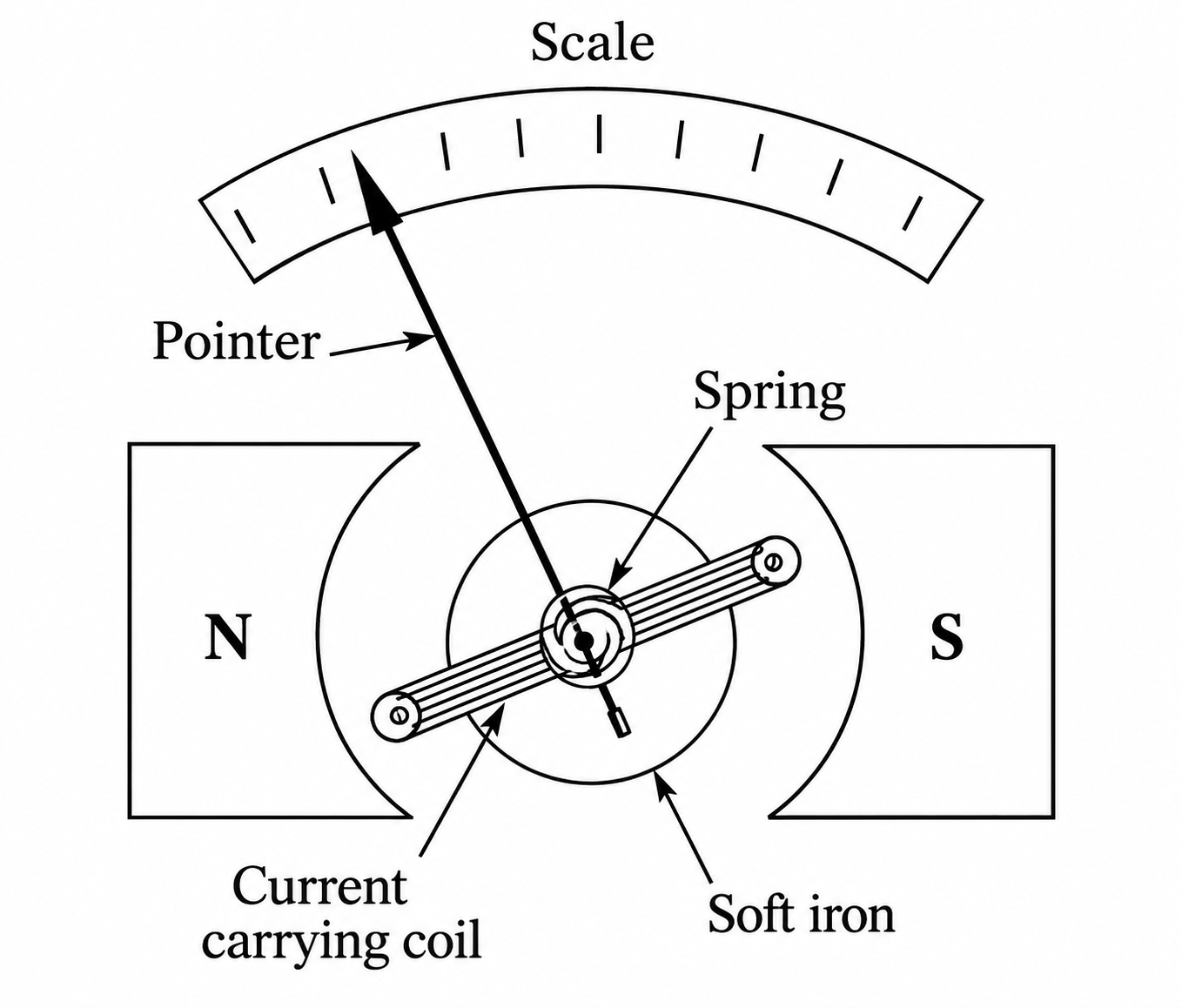
Describe the construction of a suspended-coil galvanometer with a labelled diagram. Prove that the current flowing through the coil is directly proportional to the deflection produced.

निलम्बित कुण्डली धारामापी की संरचना का वर्णन कीजिए, इसका नामांकित चित्र बनाइए। सिद्ध कीजिए कि धारामापी की कुण्डली में प्रवाहित धारा कुण्डली में उत्पन्न विक्षेप के अनुक्रमानुपाती होती है।

⭐ High-weightage derivation
Solution

diagram

Construction:- A rectangular/circular coil of fine wire is wound on a light non-magnetic frame and suspended between the curved pole pieces of a strong permanent magnet, with a cylindrical soft iron core FIXED (stationary) at the centre to produce a radial field. It is the COIL — not the core — that is free to rotate; the coil is mounted on a spindle connected to the pointer at one end and a restoring spring at the other. Current through the coil produces a torque that rotates the coil (and pointer) until the spring's restoring torque balances it

Torque on coil = Torque on spring

BINA sinα=kθ

BINA sin90∘=kθ

BINA =kθ (k= Spring cons. )

(BNA/k)I=θ

or, θ=GI (G= galvanometer constant )

So, θ∝I (G=BNA/k)

All solved questions for this chapter are in the full RBSE Physics PYQ book.

Appeared in RBSE 2020
5 of 10 free questions previewed

The other 5 are in the free PDF — and all 31 previous-year questions for this chapter are in the full book.

Download your free Chapter 4 PDF (10 Questions)

Get 10 hand-picked previous-year questions from Chapter 4. Every question includes the exam year, marks, and repeat count. Instant download—no signup required.

How Moving Charges and Magnetism is examined in RBSE

A quick map of the chapter before you download — so you know what the questions are testing.

If you have gone through the last decade of RBSE Class 12 Physics papers, you will notice Chapter 4 (Moving Charges and Magnetism) is tested every year without fail. It belongs to Unit III — Magnetic Effects of Current and Magnetism and is drawn from a pool of 31 previous-year questions spanning 2013–2026, spread across MCQs, very short, short and long-answer sections. The topics rotate, but the question patterns stay remarkably steady.

You can expect a quick 0.5 to 1-mark opener on the direction of magnetic force or field, or a definition like the figure of merit of a galvanometer. The 2-mark questions lean on Biot-Savart law applications and galvanometer conversions. The heavy marks sit in the 4-mark long answers, which almost always ask you to derive the magnetic field on the axis of a current-carrying loop using Biot-Savart law (asked in 2017, 2021, 2024, 2025 and 2026) or to apply Ampere's circuital law to a straight wire or solenoid.

So the smart way to revise this chapter is not to read it end to end, but to practise the questions RBSE actually repeats. The five questions above — and the ten in the free sample PDF — are taken straight from real board papers and tagged with the exact years they appeared, so you can see for yourself what the full RBSE Physics chapterwise PYQ book offers before you decide to buy it.

Topics Covered in Moving Charges and Magnetism (Chapter 4)

The RBSE syllabus sub-topics this chapter's PYQs are drawn from — useful for scoping your revision even if you're not buying the full book.

  • ✓ Biot-Savart law
  • ✓ Magnetic field due to a straight wire and a circular loop
  • ✓ Ampere's circuital law and the solenoid
  • ✓ Force on a moving charge and a current-carrying conductor
  • ✓ Force between two parallel currents
  • ✓ Moving-coil galvanometer and its conversions
RBSE · PHYSICS · CH.04
FREE SAMPLE

What you get in the free PDF

  • ✓ 10 real RBSE PYQs from Moving Charges and Magnetism
  • ✓ Every question tagged with year and marks weightage
  • ✓ Repeat-frequency tags so you revise the highest-yield questions first
  • ✓ Available in Hindi and English
  • ✓ A 10% off coupon toward the full book

What students are saying

★★★★★

"Chapter 4 mein Biot-Savart law wala derivation baar baar aata hai — is list se priority samajh aa gayi."

Priyanka Chouhan
Kota
★★★★★

"Free PDF mein solid 10 questions mile, Ampere's law wale numericals bahut kaam aaye."

Rohit Suthar
Udaipur
★★★★★

"Year-wise tags dekh kar revision plan banana easy ho gaya. Poora 14-chapter book bhi le liya sirf ₹59 mein, paisa vasool."

Ananya Sharma
Jaipur

What's inside this chapter in the full book

The ₹59 full book unlocks all 31 tagged previous-year questions for Moving Charges and Magnetism — plus all 13 other chapters.

📄

All 31 real PYQs

Every MCQ, VSA, SA and long-answer question for this chapter from RBSE papers 2013–2026 — 31 in total.

🏷️

Tagged & sorted

Each question labelled with year, marks and question type.

🔥

Repeat-priority order

Highest-repeated questions listed first so revision time is spent well.

🇮🇳

Hindi + English

Full bilingual coverage — study in whichever medium you write your exam.

➗

Formula sheet

Quick-reference sheet of every moving charges and magnetism formula — Biot-Savart law, Ampere's circuital law, solenoid and galvanometer formulas.

📅

2026–27 edition

Updated to the latest RBSE board pattern, with access valid for the current 2026–27 exam session.

Frequently asked questions

The most-repeated question in this chapter is 'Write the formula of Biot-Savart law in vector form. Obtain an expression of magnetic field on the axis of a current-carrying loop. Draw the necessary diagram.' (asked in RBSE 2017, 2021, 2024, 2025, 2026). It's followed by 'Write Ampere's circuital law in mathematical form. Draw a diagram and derive an expression for the magnetic field on the axis of a current-carrying solenoid.' RBSE (Rajasthan Board of Secondary Education) repeats these patterns closely each year — our free PDF tags every question with its exact repeat count.
Yes. Moving Charges and Magnetism is a core topic in Unit III — Magnetic Effects of Current and Magnetism and is tested every year through MCQs, very short, short and long-answer questions in the RBSE Class 12 Physics board paper.
The full RBSE Class 12 Physics Chapter 4 (Moving Charges and Magnetism) question bank has 31 previous-year questions from 2013 to 2026 — MCQs, very short, short and long-answer. The free sample PDF gives you 10 of them; the full book has all 31.
Yes. When you request the PDF, choose English, Hindi, or Both — the free sample and the full book are available in both mediums, so you can revise in whichever language matches your school textbook and RBSE board exam medium.
10 real RBSE previous-year questions from this chapter (out of 31 total), each tagged with year, marks, and repeat frequency. Questions only — no solutions — so you can self-test before checking the full solved chapter.
No account or email signup is needed. Just share your name and phone number and the PDF is available to download instantly — no payment and no waiting. Your number is only used to send the download link.
SAVE 40%

Get all 14 chapters of RBSE Class 12 Physics at ₹59

₹99 ₹59

One booklet, every chapter, tagged and sorted by repeat priority — in English and Hindi.

See full book — ₹59 →