What is meant by rectification? Draw the electric circuit diagram of a half-wave rectifier, describe its working, and draw the input and output voltage waveforms.
दिष्टकरण से क्या तात्पर्य है? अर्द्धतरंग दिष्टकारी विद्युत परिपथ का चित्र बनाइए। इसकी कार्यप्रणाली का संक्षिप्त विवरण लिखिए। इस दिष्टकारी परिपथ के लिए निवेशी वोल्टता तथा निर्गत वोल्टता के तरंगरूप का चित्र बनाइए।
🔥 Most repeated · asked 2×The process of converting alternating current (AC) into direct current (DC) is called rectification
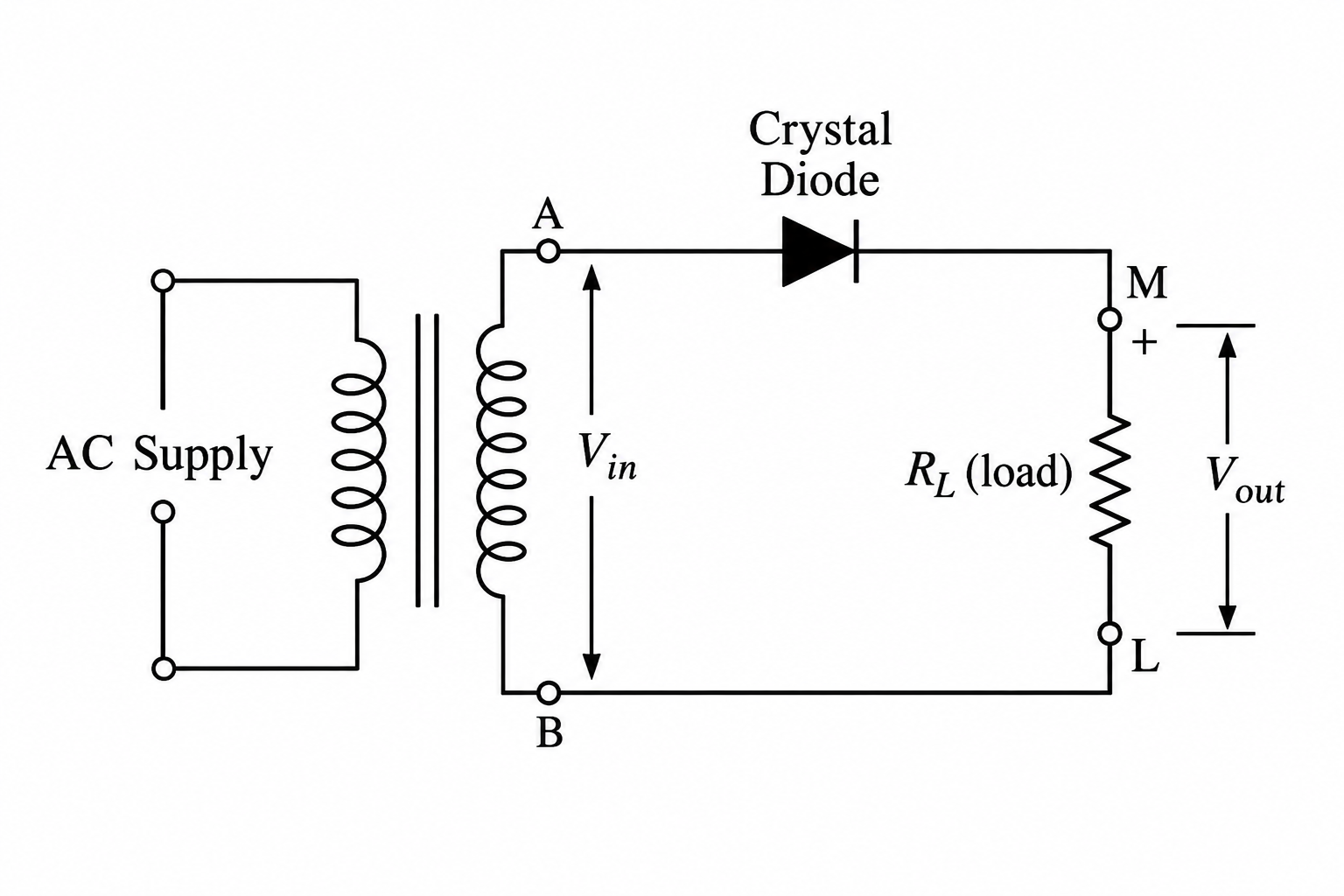
A half-wave rectifier converts alternating current (AC) to pulsating direct current (DC) by allowing only one-half cycle of the input waveform to pass to the output while blocking the other half
It typically consists of a transformer, a single diode, and a load resistor
Working Principle
The operation is based on the one-way conduction property of a diode:
Positive Half-Cycle:
The AC input voltage makes the anode of the diode positive with respect to the cathode
The diode is forward biased and acts like a closed switch (it conducts)
Current flows through the diode and the load resistor, producing an output voltage across the load
Negative Half-Cycle:
The AC input voltage reverses polarity, making the anode of the diode negative with respect to the cathode
The diode is reverse biased and acts like an open switch (it does not conduct)
No significant current flows through the circuit, resulting in zero output voltage across the load
The output voltage is a pulsating DC signal, consisting of only the positive half-cycles of the original AC input, separated by periods of zero voltage. This output requires further filtering (using capacitors or inductors) to become a smooth, usable DC voltage
All solved questions for this chapter are in the full RBSE Physics PYQ book.